

You rank #1 on Google. ChatGPT has never heard of you.
Open a new tab right now and ask ChatGPT for the best tools in your category. Go ahead, I’ll wait. If your brand isn’t in that answer, you just watched a sale walk out the door, and your analytics will never show you it happened. That’s the uncomfortable new reality, and it’s exactly the blind spot we built Topify to close.
Here’s something hitting a lot of B2B teams right now. You spent years building domain authority. You rank page one for your money keywords. Then a prospect asks ChatGPT for the best tools in your category, and your name never comes up. A competitor with thinner SEO gets the recommendation instead, and you never find out it happened.
It’s not hypothetical. ChatGPT passed 900 million weekly users in early 2026, and AI search traffic tends to convert better than a cold organic click, because the engine already did the vetting for the buyer. By the time someone clicks through, they’ve been pre-sold. If you’re invisible in that answer, you’re quietly losing deals you can’t even see in your analytics.
The discipline that fixes this has a name now: Generative Engine Optimization, or GEO. It’s the practice of getting your brand mentioned and cited inside AI answers, the same way SEO got you ranked in blue links. The good news is that it’s measurable and improvable. Here’s a practical five-step framework to do it, plus a few shortcuts we lean on at Topify.
First, it helps to understand why a #1 Google ranking doesn’t automatically buy you an AI mention. Search engines retrieve and rank existing pages. Generative engines do something different: they read across many sources, weigh which ones feel authoritative and consistent, and then write a single synthesized answer. A blue-link ranking is a vote for one page. An AI citation is a vote for your brand as the answer. Those are related but not the same, which is exactly why a brand can dominate organic search and still go unnamed when a buyer asks an AI for a recommendation. Closing that gap is what the next five steps are about.
Step 1: Measure your baseline
You can’t fix what you don’t measure. Before touching a single page, get a clear read on where you actually stand today.
- List 15 questions your ideal customer would actually ask an AI. Not branded queries, but things like “best tools for X” and “how do I solve Y.”
- Run each one across ChatGPT, Perplexity, and Gemini. Note which brands get mentioned, how often, and which sources get cited.
- Track competitor mentions. The gap between them and you is your starting line.
One thing worth knowing: the engines barely overlap. In a study of 680 million citations, only 11% of domains showed up across multiple engines. So you genuinely have to check all three, not just spot-check ChatGPT and assume the rest match.
And don’t stop at a simple yes-or-no on whether you were mentioned. Three things matter beyond presence. Sentiment: is the AI describing you positively, neutrally, or with a caveat? A lukewarm mention can hurt more than no mention. Position: are you named first in the answer or buried at the bottom, where most readers never reach? Share of voice: out of all the brands named for a given query, what slice is yours? Those three turn a vague feeling of invisibility into numbers you can actually move, and they’re the difference between knowing you have a problem and knowing exactly how big it is.
Doing this by hand across three engines and fifteen queries eats four to six hours every month, and it’s stale the moment you finish. This is the part we built Topify for. You plug your prompts in once, and it tracks visibility, sentiment, and share of voice across every major engine, then gives you a breakdown like this:
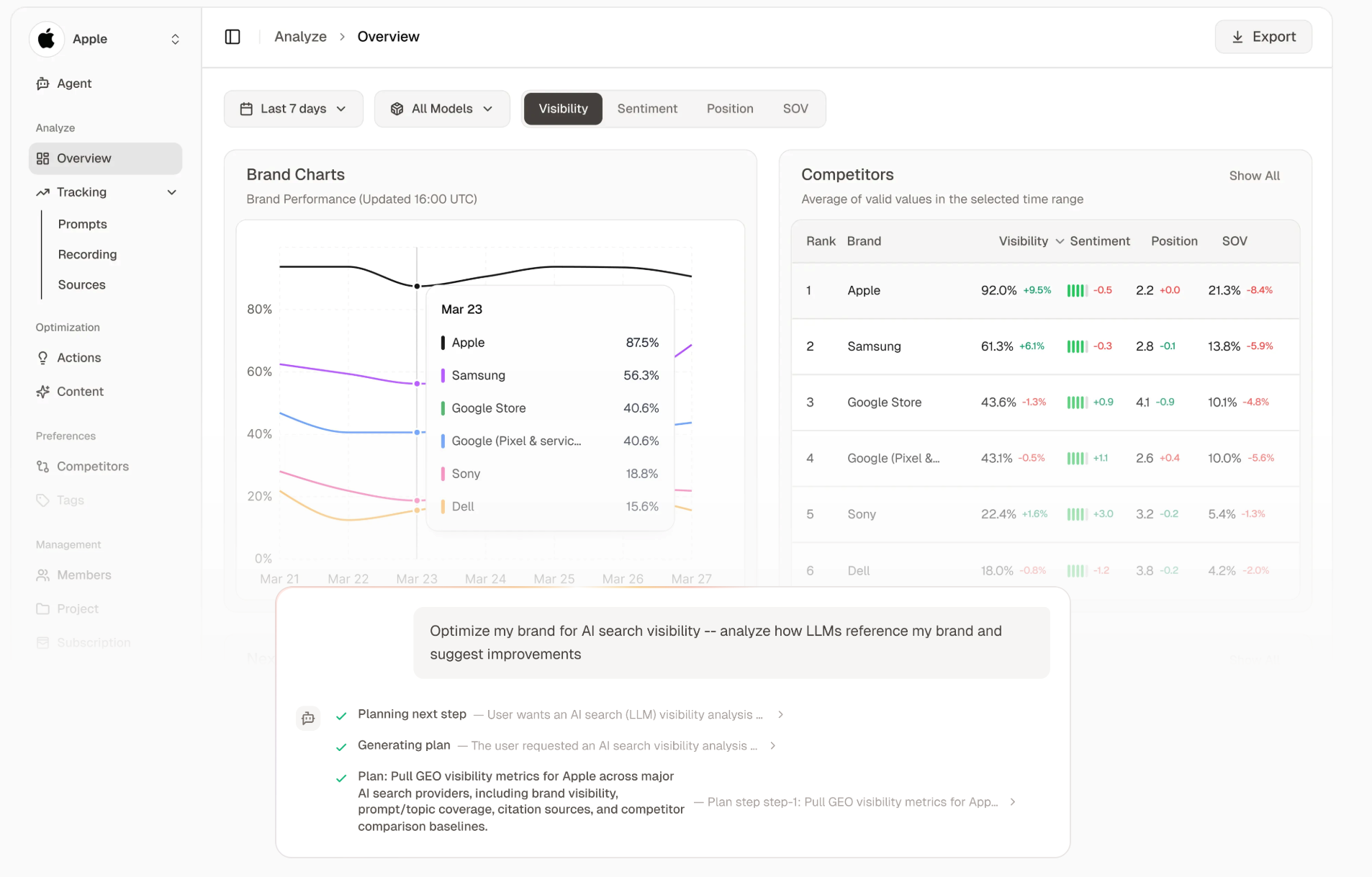
A Topify visibility dashboard: brand trend lines on the left, a live competitor table on the right (brand names anonymized here). One screenshot shows exactly where you sit versus the field.
If you just want a fast read before committing to a full process, the free GEO tools give you a baseline visibility score in a couple of minutes. For a deeper look at what to measure and why, this breakdown of AI visibility score monitoring walks through the metrics that actually matter.
Step 2: Don’t drop SEO. It still feeds AI.
A common mistake is treating GEO as a replacement for SEO. It’s not. It’s a layer on top of it.
Google AI Overviews still pull heavily from high-ranking organic pages. For ChatGPT and Perplexity the source pool is wider, but strong content and backlinks still raise your odds of being cited. So keep shipping quality work, and tune it for how machines read.
- Shift your quality bar from keyword density to specific, sourced claims. A page with five to seven verifiable data points gets cited far more than a fluffy one.
- Check your robots.txt. If you’re blocking GPTBot to save crawl budget, you’ll rank fine on Google and stay completely invisible to ChatGPT.
- Add an llms.txt file in your root. Think of it as the AI-era robots.txt, telling LLM crawlers which pages matter most.
If you want the full picture of how classic SEO and GEO fit together, our AI search optimization guide covers the overlap in depth, including which on-page signals carry over and which ones are new.
Step 3: Structure content so AI can quote it
This is the step that moves the needle most, and the one most teams skip. AI engines don’t read like people. They scan for liftable, quotable chunks they can drop straight into an answer. Your job is to make your content easy to lift.
- Make specific claims with data. Swap “many SaaS brands use GEO” for a sourced, concrete number. Higher fact density per 100 words correlates with more citations.
- Write headings as questions. Use “How does ChatGPT decide which brands to cite?” instead of “ChatGPT Citation Logic.” Question headings map directly to how people prompt.
- Add schema markup. FAQ, HowTo, and Organization schema each give engines an explicit signal about your structure and authority.
- Build clusters, not scattered posts. Five tightly linked pieces on one theme beat fifty random ones. Hub-and-spoke depth signals topical authority.
Auditing schema and structure across a few hundred pages by hand is a nightmare, so this is another spot where Topify’s scan flags the gaps for you instead of you clicking through every URL. If you want to understand the mechanics first, this piece on how LLM citation tracking works explains what the engines are actually looking at.
Step 4: Get into Reddit and UGC
This one surprises people. Reddit is the single most cited domain across every major AI platform. In one analysis it showed up in over 150 million citations. The reason is simple: Reddit holds the only large public archive of specific, experience-based answers, and that’s exactly what AI engines reach for when someone asks for a real recommendation.
- Find the threads. Run your core query in Perplexity and look at the citations. The Reddit threads that appear are the conversations shaping AI answers in your category.
- Contribute first. Spend two to three weeks adding genuine value in those subreddits without pitching anything. Earn the right to be there.
- Recommend honestly. When a recommendation thread shows up, be one option among several, with trade-offs. Communities punish shilling fast, and so do the engines that learn from them.
Reddit’s citation share isn’t static either. It can swing within weeks after a platform change, which is why it’s worth keeping an eye on which threads are actually driving citations rather than setting it and forgetting it. Quora, Stack Overflow, and niche industry forums follow the same logic on a smaller scale, so don’t ignore the UGC platforms where your specific buyers already spend time.
Step 5: Win listicle placements
When ChatGPT or Perplexity writes “best X tools,” it isn’t reasoning from scratch. It’s synthesizing existing listicles, roundups, and comparison pages. That’s why brands are far more likely to get cited through third-party pages than their own domain. One placement in a strong roundup can outperform ten of your own blog posts.
- Run your recommendation queries through ChatGPT and Perplexity, and note which listicles get cited. Those are your targets.
- Pitch those editors for inclusion with clear differentiators and data, not a generic ask.
- Where outreach won’t land, publish your own honest comparison piece, competitors included, and distribute it.
- Keep your G2, Capterra, and Trustpilot profiles complete. Those listings meaningfully raise your citation odds.
Knowing which queries to chase is half the battle. Our roundup of the best AI query tracking tools covers how to find the prompts and listicles worth targeting, so you’re not pitching blind.
A simple 90-day cadence
None of this has to happen at once. Here’s a sequence that’s worked for teams starting from zero:
- Weeks 1-2: Run your baseline across all three engines. Audit robots.txt and schema on your top 20 pages.
- Weeks 3-6: Rewrite 5 to 10 cornerstone pages with question headings, schema, and data-backed claims.
- Weeks 7-10: Start Reddit participation in 3 to 5 subreddits. Identify your listicle targets.
- Weeks 11-12: Run listicle outreach, update your review profiles, then re-run your baseline and compare.
Most teams that follow this see measurable movement in citation frequency within 60 to 90 days. And the effects compound, because every citation makes the next one more likely.
A few questions teams always ask
1. How often should I re-check my visibility?
Monthly is the floor for most teams, weekly if you’re in a fast-moving category or running an active GEO push. AI answers shift more often than Google rankings do, so a quarterly check will miss real movement.
2. Do I need to track every engine?
Track the ones your buyers use. For most B2B audiences that’s ChatGPT, Perplexity, and Google AI Overviews at minimum. Because the engines overlap so little, winning one doesn’t carry over, so pick your priority engines deliberately rather than assuming they move together.
3. Is GEO just a fad?
The behavior driving it, people asking an AI instead of typing a query, is already mainstream and still growing. The tactics will keep changing, but the underlying shift of AI sitting between your brand and your buyer is not going away. Treating it as a permanent channel rather than a one-off project is the right mindset.
Start with a baseline
The highest-leverage thing you can do today is simply find out where you stand across ChatGPT, Perplexity, and Gemini. Topify’s free GEO Visibility Report gives you that in minutes, with a one-click screenshot of your citation breakdown you can drop straight into a deck. Run it once and you’ll know exactly which of these five steps to start with, and which competitor you need to catch first.